











About the Endocrine System
The endocrine system is a complex network of glands and organs that produce, store, and secrete various types of hormones. The different types of hormones created by the body act as "messengers" to coordinate many functions within our bodies including mood, growth and development, tissue function, and metabolism. In short, the endocrine system is one of the body’s main systems for communicating, controlling and coordinating the body’s work.
To function normally, the body needs a system for controlling how hormones are produced and used, a blood supply that works well to move hormones through the body to their target points, and receptor places on the target cells for the hormones to do their work.
If your hormone levels are too high or too low, you may have a hormone disorder. Hormone diseases also occur if your body does not respond to hormones the way it is supposed to. Stress, infection and changes in your blood's fluid and electrolyte balance can also influence hormone levels.
Endocrine health conditions are common and include diabetes, thyroid disease, parathyroid disorders, pituitary disorders and osteoporosis.

Anatomy of the Endocrine System
The glands that make up the endocrine system include the hypothalamus, pituitary, thyroid and parathyroid, adrenal, pancreas, and ovaries and testes.
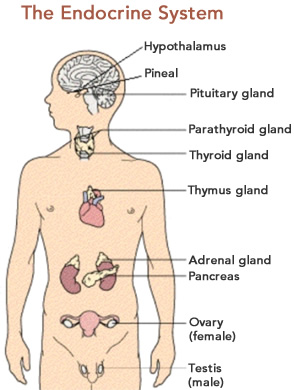 Hypothalamus
The hypothalamus is located in the brain, near the optic chiasm. It secretes hormones that stimulate or suppress the release of hormones in the pituitary gland, in addition to controlling water balance, sleep, temperature, appetite, and blood pressure.
Pineal body
The pineal body is located below the corpus callosum, a part of the brain. It produces the hormone melatonin.
Pituitary
The pituitary gland is located at the base of the brain. No larger than a pea, the gland controls many functions of the other endocrine glands.
Thyroid and parathyroids
The thyroid gland and parathyroid glands are located in front of the neck, below the larynx (voice box). The thyroid plays an important role in the body's metabolism. Both the thyroid and parathyroid glands also play a role in the regulation of the body's calcium balance.
Thymus
The thymus is located in the upper part of the chest and produces T-lymphocytes (white blood cells that fight infections and destroy abnormal cells).
Adrenal gland
The pair of adrenal glands are located on top of both kidneys. Adrenal glands work hand-in-hand with the hypothalamus and pituitary gland.
Pancreas
The pancreas is located across the back of the abdomen, behind the stomach. The pancreas plays a role in digestion, as well as hormone production.
Ovary
A female's ovaries are located on both sides of the uterus, below the opening of the fallopian tubes (tubes that extend from the uterus to the ovaries). In addition to containing the egg cells necessary for reproduction, the ovaries also produce estrogen and progesterone.
Testis
A male's testes are located in a pouch that hangs suspended outside his body. The testes produce testosterone and sperm.
Please visit our Links & Resources web page for extensive links and in-depth downloadable PDFs.


OSTEOPOROSIS
PREVENTION


DIABETES RESEARCH

Find out about diabetes clinical trials in the Rogue Valley.

specializing in endocrinology, diabetes, thyroid disorders, and osteoporosis.
Southern Oregon Internal Medicine | 2900 Doctor's Park Drive, Suite 200, Medford OR 97504 | Phone (541) 282-2200 | Fax (541) 282-2237
A Rogue Valley Physicians, PC clinic